"Why Do the Heathen Rage?"
ACT Up, Bad Bunny, G.K. Chesterton, Linda Ronstadt, Sandy Denny, Flannery O'Connor

I’m speckling recent reading about 20th c (post?-)Catholic literary, pop, and aesthetic trends with middling musings on music, sex, and countercultural ripples. It may not add up to an elegant let alone definitive statement. I lean into moderate or measured material as a counterweight to both incessant groupthink and tendentious clickbait but without necessarily endorsing any statement. It's where I now roam to pluck low-hanging, no-paywall, fruit, out of both my academic druthers and quixotic inclination to offer viewpoints few of you if any may have been exposed to outside one's silo. But given I’m reduced to thumbs on a Kindle, forgive my contrarian jumble. As another Valentine’s Day, the second without my mate of 36 years, flits, perhaps my highlights may commemorate how mutual fumblings infuse legacies of family and as firm love.
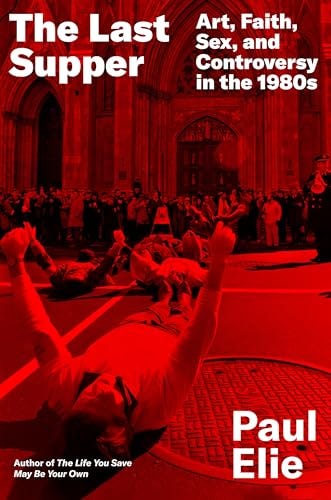
July 11th 2025: Christopher Caldwell reviewed Paul Elie’s latest book in The Lamp
Two decades ago, the editor and intellectual historian Paul Elie wrote The Life You Save May Be Your Own, a critical biography of four questioning Catholic writers that put the shoe thrillingly on the other foot. The social worker Dorothy Day, the fiction writers Flannery O’Connor and Walker Percy, the literary monk Thomas Merton—these were the courageous skeptics, the renegades, the living counterculture of the American Century. It was the striving, thriving country of the 1940s and ’50s—usually lionized back then as the Greatest Generation—that was judged for its superstitions and found wanting.
In The Last Supper: Art, Faith, Sex, and Controversy in the 1980s, Elie attempts a similar feat with a newer group of writers and artists. He is convinced that we are living amidst a paradox that first became evident about forty years ago. Ours is “an age in which religious belief seems to be at once in steep decline and surging out of bounds.”
. . .Powerful sociological factors made it almost inevitable that the Church would eventually clash with the secular world over sex. Demographically the 1980s were set to be the most sexual decade in the history of the country. The vast generation of the Baby Boom—a third of the population—was in its sexually active years for the whole time: aged sixteen to thirty-five at the decade’s beginning, twenty-six to forty-five at the end. And the so-called Sexual Revolution had happened. Effective birth control was universally available. So was abortion. . .
Vatican II opened a sociological fault in the middle of the Baby Boom generation. Any Catholic over thirty when the 1980s began had been accompanied through puberty by sex doctrines identical to those his father had learned, and his father’s father, and so on back through the centuries. Any Catholic under thirty was living in a different religious civilization, effectively under a secular dispensation. The Church taught many of the same things, but—how to explain it?—they seemed more historic than vital, rather like learning a dead language. Numerically these groups were of equal size—thirty happened to be the median age in 1980. The older half held the institutional power; it made doctrine. The younger half was having all the life experiences. It was forging its sexual way in a world that seemed to have abandoned all inherited rules. . .
The sexual revolution of the 1960s and ’70s was part of a more general dissolution of the compromise between modernity and tradition—to the detriment of the latter—of which Vatican II was symptom as much as cause. Uncoincidentally, the decades of the Seventies through the Nineties overlap with the ones in which the political scientist Robert Putnam placed the latest of America’s “great awakenings.” The arguments these developments provoked appeared ideological at the time, and appear so still to Elie and others. It is better, though, to think of them as contingent and ultimately tragic. In the early 1980s, a generation that had been assured that the moral strictures against sexual experimentation were baseless, antiquated, and ridiculous was confronted with sex-borne plague of biblical severity. Rightly or wrongly, it was natural for us to feel not only lied to by those who had espoused the new doctrines but also mocked by those who espoused the old. . .
Yalie Caldwell’s nearly my exact GenJones cusp contemporary, so his charting of the generational then-rupture in parish indoctrination, or its vapid nadir during what Bishop Robert Barron sums up as our “banners and balloons” in “beige Catholicism,” rings very true. My parents bought me in ‘69 the superseded Baltimore Catechism: it inspired and terrified in its line drawings which did the Lord’s work, spurring my eventual dissertation (!) on my nascent Big Question, the idea of purgatory…albeit in Middle English…yeah, every doctoral tome sounds risible…but it does end with Hamlet.
Also in The Lamp, Feb. 13th, 2025: editor half “our” age Matthew Walther expounds on the “Technological Poverty”...whither most of my fellow ‘Muricans (no matter where across captive twinned big-screen continents christened after Amerigo Vespucci, as my irascible chronicler correspondent Matt Cavanaugh elaborates on Stupor Bowl LX Bad Bunny’s (slyly muffled for the arena masses) vulgarity, courtesy of a Boriqueñan bricolage blast—Rolling Stone deciphered its piquant Puerto Rican signifiers if not what's alluded to by MC as Reggaeton Hapa”) gape at as stuffed cheesy bread (who am I to dismiss my dining deseridatum after stuck for years crustless in Ecuador: in a single sitting I’ll scarf a large white pizza) and bloated NFL circus. (Being cable-less and my black mirror serving as scarf stand and blank Spotify streambar on my belt-tightened budget, I didn't tune in. I append for accuracy how my close pals countered how impressed they found the Up With Gente spectacle, affirming deep-blue-state aspirations of inclusion, open borders, and giddy glee. Apparently “outrage” about El Conejito Malo's lusty chortling comes from party poopers—my NorCal comrades call them Americataliban—transcribing spicy recordings rather than broadcast versions.)
“Unlike the picturesque, the technologically poor do not experience their poverty as such. Once upon a time when a hungry boy saw a well-fed one he might have envied him. Today he may not even see him. A seven-year-old boy spends five or more hours a day at school interacting with a laptop or tablet device before going home to waste time in front of the “smart” T.V. or a phone or a video game console. In a few years he will become one of the forty percent of Americans who suffer from prediabetes. By age twelve at the latest he will become addicted to online pornography. In adulthood he will be on insulin (his doctor will recommend an app for monitoring his blood sugar; a pharmaceutical company will bill insurance). He will take other medications. He may get a job. He may father a child. He will not kick the porn habit. He will watch four thousand hours of YouTube. He will not think of himself as poor. No one will tell him that he is. One day he will see a man who is looking at a bird. Will he envy him?”
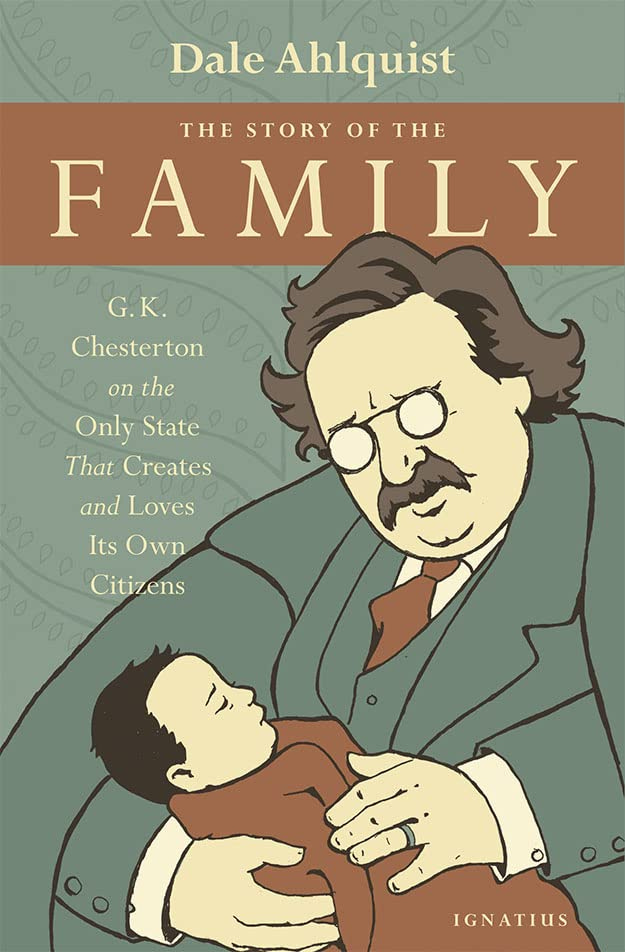
The Story of the Family: G. K. Chesterton on the Only State that Creates and Loves Its Own Citizens, ed. Dale Ahlquist. My review. Three stars at Goodreads.
Although GKC died going on a century ago, his thoughts remain both pithy and digressive. A master of rhetoric, he could somehow spin fabulous yarns, argue dense propositions, and entertain audiences who couldn’t all have been swayed by his intellect, but surely never forgot his presence, formidable in size and sensibility. I doubt if many still read the essays of HG Wells, or the ripostes of GB Shaw, his foils and friends, contrasted with Chesterton’s enthusiasms, which even if inevitably needing footnotes as Dale Ahlquist adds, might often delight.
Ahlquist as an extremely prolific supporter of GKC in my opinion tends to glide past his subject’s shortcomings, all the same. Catholic conservatives championing him underplay how many of us—less secure than those funded by think tanks and more precarious given our bank balance in the 21st c—embed ourselves in relationships of friendship, family, and acquaintance with our own circle which increasingly includes those of different sexual orientation and “unsanctioned” gender identities. Few can retreat into “intentional” or religiously rigorous communities. I admire a lot in GKC, but as with many of his colleagues then or now, their rigid rejection of acceptance on a practical basis of everyday lives encompassing the coming out of loved ones--and security embedded if amidst laxer moral standards and social norms--isn’t reality for billions living in our majority secular Western culture.
“We” can’t all homeschool, hunker down to harvest our own crops, handle another infant every fifteen months, and homestead ourselves. While I sympathize with those lamenting the ebbing of the lofty regimen which shaped my Irish-to-America family and culture, I witnessed ground-zero damage that glib papal dictate, parochial and peer pressure, relentless guilt, sexual shame, closeted clergy, “out of wedlock” births with their aftermath, episcopal scandal, Humanae Vitae, abandonment of spouses “married in the Church,” and bitter estrangement wreaked. And I grew up the very first cohort after Vatican II...
Anyway, as Ahlquist peppers his bulky text with a barrage of quotes before each short essay in the thematic chapters, I’d advise not diving in straight, cover to cover. The material rewards dipping into. And highlighting (as my Goodreads review shows), for while repetitive at times, given the journalism which kept GKC’s bread buttered, it demands contemplating at leisure, not skimming on screen. That pace suits too GKC’s admirable pace, as his sentences sound to one’s ear as they’re perused. His cadences keep rhythm with his thinking through his arguments on paper.
While you may expect lots of fulminating against flappers or scorn of suffragettes, instead you’ll find surprisingly sharp criticism of capitalism more than communism and reminders of what happens when the unborn stay that way forever, when divorce by nobody’s fault seldom results in fairy-tale mutual happiness, or when domestic unity breaks apart under pressures to work closer to one’s venal employer than one’s kin. And then there’s the sex drive, wedding vows (great insight), promiscuity, mass compulsory education, sociologists, bureaucrats, legislative decisions imposed as political policy, what we call “universal childcare,” and what GKC would have excoriated indelibly, our current celebration of “shout your reproductive healthcare.”
And if you have reservations about his antiquated, distributist, and Catholic causes, still take time to hear him out. Many of us witness the balance sheet of what the Pill, legal access to contraceptives, the acceptance of non-marital arrangements, and hooking up these tumultuous sixty-plus years by now has tallied, and of the opponents and defenders of tradition vs “blended” or “chosen” families, and of those claiming that a spouse deserves liberation from an abusive partner, or a child from incompetent couples unfit for each other let alone raising offspring (the latter two situations GKC never tackles seriously; he wasn’t a father) means freedom for individual fulfillment.
One can’t blame Chesterton’s lack of a crystal ball. GKC didn’t live to see our current preoccupations with gender fluidity, alternative, same-sex, and/or “follow your bliss” transitory arrangements, the prevalence of “single moms” and “guardians” and step-relations galore in combination or solo beyond if not his imagination than at least what the welfare State, the atomization of choice by consumers of hedonistic and commodified lifestyles, pro-choice legal consensus, polyamory, and “serial monogamy” have engineered. Not to mention what he thought of cinema and radio, as predecessors to our social media and erotic influencers; GKC showed perspicacity!
P.S...re: protests…Stop the Church action was before Christmas 1989, when members of the AIDS Coalition to Unleash Power (A.C.T. U.P.) disrupted a Mass at Saint Patrick’s Cathedral and desecrated hosts. Elie makes an arcane argument that by failing to accede to gay identitarian movements within the Church, the Church itself had actually committed the desecration. “The Church had failed to grasp the full significance of sacred space,” Elie writes. “It was a big fail.” He considers the protest to have been a victory for A.C.T. U.P. but thinks the Church should have been grateful, too, for the fury of the communicants at Saint Patrick’s—that was evidence of how seriously they took the Real Presence! (One of those activists attended Son #1’s bar mitzvah, surely a first for a Derryman in many a clan on either side of The Big Pond.)
[N.B. from the UnBelievable podcast I heard as I drafted this, quite apropos. Jeremy Boreing, a rare evangelical Hollywood screenwriter, turned co-founder of conservative site The Daily Wire, credits the CBS series “Will & Grace” for changing the “social imaginary” which had Obama entering his presidency opposed to “gay marriage” before endorsing “marriage equality” in post-2012 (admittedly lame-duck) which Trump had to follow in his campaigns. My interest in this issue, as a “straight white guy,” might be traced to analogies to the cynical Mexican “Institutional Revolutionary Party”--that is, how long can a one-time subversive cause keep its clout once it’s embedded itself into law, education, “faith-based initiatives,” taxes, ads, foundations, and big business? After legalization occurs, one won’t dismantle the lobbyists’ system. What happens to fundraising and ginning up our can’t-be-complacent cadres as a Third Wave? Deep-pocket donors and voters must be eternally unsettled (where I aver despite the tendentious term, “cultural Marxism” seems it fits) by savvy operatives mocking convention, risking an undermining of support they’ve achieved for the greater cause, as grifters spur provocation, photo-ops, politicos, and (“non-”)profits.
“Why the West Can’t Escape Christianity” Jan. 26th 2026. Jeremy Boreing with John Nelson. Premier UnBelievable podcast.
Footnote: a second mention—with another round of muted applause from critics on the right—of the quality of the depictions on “Will + Grace” as vanguard for this quite rapid post-millennial turnaround pops up re: queer liberation, coming out, uh, despite or due to disgust at a 70’s “Three’s Company” flamboyant flounce amidst parade pride or club posing (though Scott Yenor doesn’t fully frame this paradigm shift from First Wave outrage to Second Wave “normality”—eliding any impact of AIDS) before the 1990 book After the Ball and P.R. “same-sex” rebranding segue into Beltway buzzwords of dignity, acceptance, and do ask, do tell, integration. In the quip of this interviewee: “We’re going to make you respect us by showing you we don’t care what you think.”
Feb. 12th 2025: “The Promises of Gay Liberation.” Scott Yenor talks with editor R.R. Reno. First Things Podcast.
P.P.S. I never viewed this show but maybe it made its mark in the manner Norman Lear’s sitcoms had in my Nixonian adolescence. Boreing emphasizes how “Will” during the Obama Administration occupied the final pivot in altering mainstream reactions to gay rights among a significant chunk of “Middle America” (or at least its coasts?) via legacy media before the fragmentation of audiences away from what I dimly recall peddled as network “Must Watch TV.” Which I didn’t. I insert apposite notes alongside GR snippets from yet two more of Ahlquist’s GKC anthologies.]
Ahlquist: The homosexual fad—and yes, it is a fad—is another attack on the family, and it has to do with the same argument about feminism.
Me: Ignores the civil rights issue: one might as well insist on bringing back slavery, denying the women’s vote, Jim Crow, or apartheid. The Left has embedded equality and liberty in “Western” 20\21 c law and institutions, and many even on the Right (and religious establishments) have acquiesced tacitly “or agreeing to disagree” rapidly. The more “ordinary people” witness at work, in their families, among friends “coming out” as the norm, the faster prejudice crumbles. {It’s a secular consensus.} GKC couldn’t admit in his stricter era the “homosexual” orientation of many spiritual helpers--professionally or personally--outright; while today DA refuses to acknowledge this undeniable (arguably disproportionate in liberal Christian, pagan, Buddhist, New Age, and Jewish circles) sagacious prevalence.
[Personal rejoinder. Considering the influence of many who’ve taught me in spiritual settings, whether mentors among clergy, lay Franciscans, dharma-guides, and/or plain-ol’ conversationalist friends, students, peers, classmates, profs, and acquaintances, my running tally tips high into all letters of the LGBT community. As in past and present. As in primary confidants. Some chosen, some appointed or recommended as ideal matches. Far beyond “ten percent,” the title of the gay newspaper of my UCLA stint.
Nevertheless as I persist, I side with those who've bestowed affection upon me, and my mispochah at “our” three marriages, as truer exemplars to fidelity, perseverance, promises of commitment, humor, wit, and wisdom…not the strained blithe jollity of rigid apologists for Rome Rule. How this dogmatic discrepancy can be reconciled with Ahlquist’s snide, uncharitable dismissal I leave to the Shekinah, देव, random quantum wave fluctuations, the Dao, יהוה, the number 47, whatever emanation all of us may encounter in whichever Omega Point we may waft, preferably a be-in neural flameout blast post-DMT. Or if Aldous Huxley, after his wife dosed him lysergically the same November day C.S. Lewis and JFK left us: but wouldn’t an acid hit run ragged karmic readiness as he entered his latest, terminal if not last, bardo-trip?]
Later, Ahlquist echoes GKC on divorce--but might this be a necessary evil in cases of abuse of a spouse or inability to nurture offspring? Can birth control liberate mothers to space out pregnancies or limit them for health, the greater good of stability in a family? I agree abortion is wrong, but legalization appears beneficial to safeguard the risky procedure vs back-alley circumstances, as its prohibition cannot be enforced under our current circumstances. You don’t enact legislation impossible to carry out. Yet I fear future generations may condemn our rationalization as we do slaveowners.
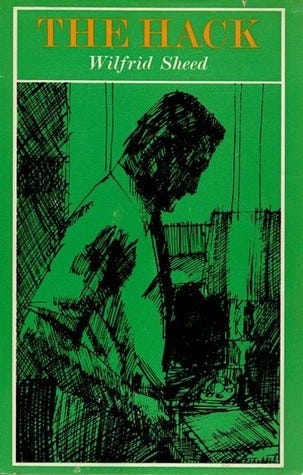
[Whatever his rumbustious fulminations, GKC’s relentlessly quotable--though my tolerance remains far lower than Ahlquist and his hail fellow well-met cabal--and an insistent entertainer. Catholic apologist GKC comrades in Hyde Park’s Speaker’s Corner, transplanted Aussie Frank Sheed and his wife Maisie Ward founded a once-lionized papist publishing house; son Wilfrid, in a mordant takedown of a lapsed pen-pusher for pious hire, in The Hack (1963; my review linked: two stars), has protagonist Bert Flax mope about as a self-lacerating freelancer (with a weary helpmeet pushing out a rugrat annually) who mutters not to “crib Chesterton” while adding after a downbeat (the entire narrative is such, not a recommendation) that “even” GKC’s falling out of fashion by then. When I was an undergrad at Loyola Marymount in Reagan’s first term, the neo-ortho Ignatius Press began to reissue his collected works, but my semi-Jesuit campus (with as many former as dwindling vowed Jebbies) embraced liberation theology, Penny Leroux, Sandinistas, Berrigan Bros, Blase Bonpane, Gustavo Gutierrez, Leonardo Boff, Mary Daly, nuns yelling at Pope JP2: whatever Marxians-meet-Küng, Rahner, Radford Ruether, and Maryknoll mixed with singalong guitars. However, they did introduce me to Percy, Day, and O'Connor; I’d already checked out Merton’s Seven Storey Mountain at the impressionable age of 12.]
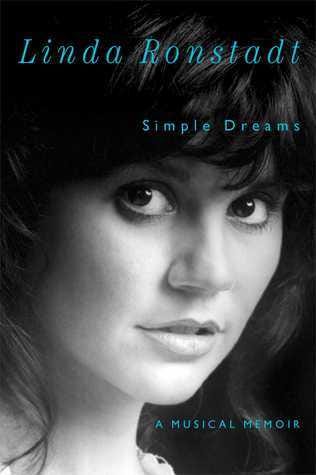
Linda Ronstadt. Simple Dreams: a Musical Memoir. Three Stars on Goodreads. My review.
It’s facile to rosy-tint any pre-conciliar ambiance, sure. Linda Ronstadt, whose fidelity to Mother Church barely survived past infancy, regales with a cautionary tale from her first-grade Tucson classroom. Imagine the early 1950s, nuns swaddled in wool layers, starched wimples, and lace-up boots year-round, resigned to corralling nearly fifty kids, no air conditioning but the Sonoran desert wind. Having opened the window, when its dry gusts topple and then decapitate a Marian statue, imagine consequences for those disciplined rugrats and gold stars accrued...no Queen of the May pachanga.
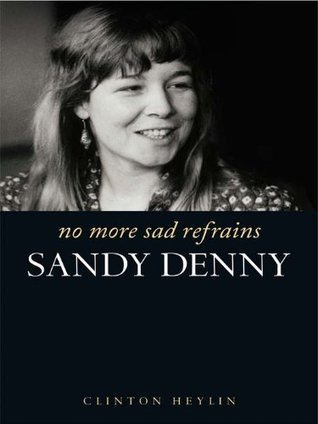
Clinton Heylin. No More Sad Refrains: the life and music of Sandy Denny. Four Stars on Goodreads. My review.
Peek at notebooks of her contemporary from across the water--I keep wondering if they ever met via amorous Lowell George or at L.A.’s Troub--Sandy Denny, who almost never touched on faith: “Religion is too much like wire netting on either side of The Path, which it reveres, and to which it adheres. But the bright and wily fox will always search and find escape [… Any wily fox can find a hole in the wire netting …] It must be there. For perfection is so rare. And then how different the aspect of the path becomes from the wide and boundless space without.” As her biographer opines--SeaOrg was after her purse, while she manfully tried in typically flirtatious and/or chemically altered fashion to cop a feel off a cute auditor--”So much for Scientology.”

Pete Shelley, Ever Fallen In Love: The Lost Buzzcocks Tapes: my review. Four Stars on Goodreads.
“Other people are archetypes whom I’m subjected to.”

Christopher Beha, What Happened to Sophie Wilder. Three Stars on Goodreads. My review.
{Snippet inevitably in The Lamp from this 80s NYC cradle Catholic-turned atheist-now skeptic’s forthcoming Why I Am Not an Atheist}
Cf. Shelley Pete not Lord Percy Bysshe: “She was against character types in theory but found them useful practically. . .”
Colophon #1: “If you don’t believe in God, how do you believe in a fucking book?” —ROBERTO BOLAÑO , 2666. . .
“Even her religious turn had its interest, a publicist had told her. (’It’s like Graham Greene or something. I mean, who converts anymore? Unless they’re converting away.’)”. . . .
“Only the man in the second row wasn’t a regular. Dressed in a suit and tie, his gray hair neatly slicked back, he knelt uncomfortably with his head bowed and his eyes pressed shut. His appearance suggested that he lived in the neighborhood, while his unfamiliarity to Sophie and the awkwardness with which he filled his pew suggested that he had entered the church impulsively that morning. Such figures weren’t uncommon at St. Agnes, though their attendance was always short-lived. Sophie inevitably wondered what spiritual emergency—illness or death or some irrevocable act the guilt of which one wished to expiate—brought these supplicants to enact unfamiliar or long-abandoned rituals among strangers. But she put him out of mind and bowed her own head until the priest stepped out from the sacristy to begin mass.”
[After venting about my agnosticism in a well-meaning Grief Share TM Let Go Let God better not bitter non-denom gathering at the local, new to me, parish, I confess this depiction stings, as I linger awake in bed long past each midnight seeking solace. I guess the Man Upstairs got one back--He tells Job “because I said so” in Bill Cosby paternal role--as I lost my beanie in the drizzle after taking off my raincoat hood.]
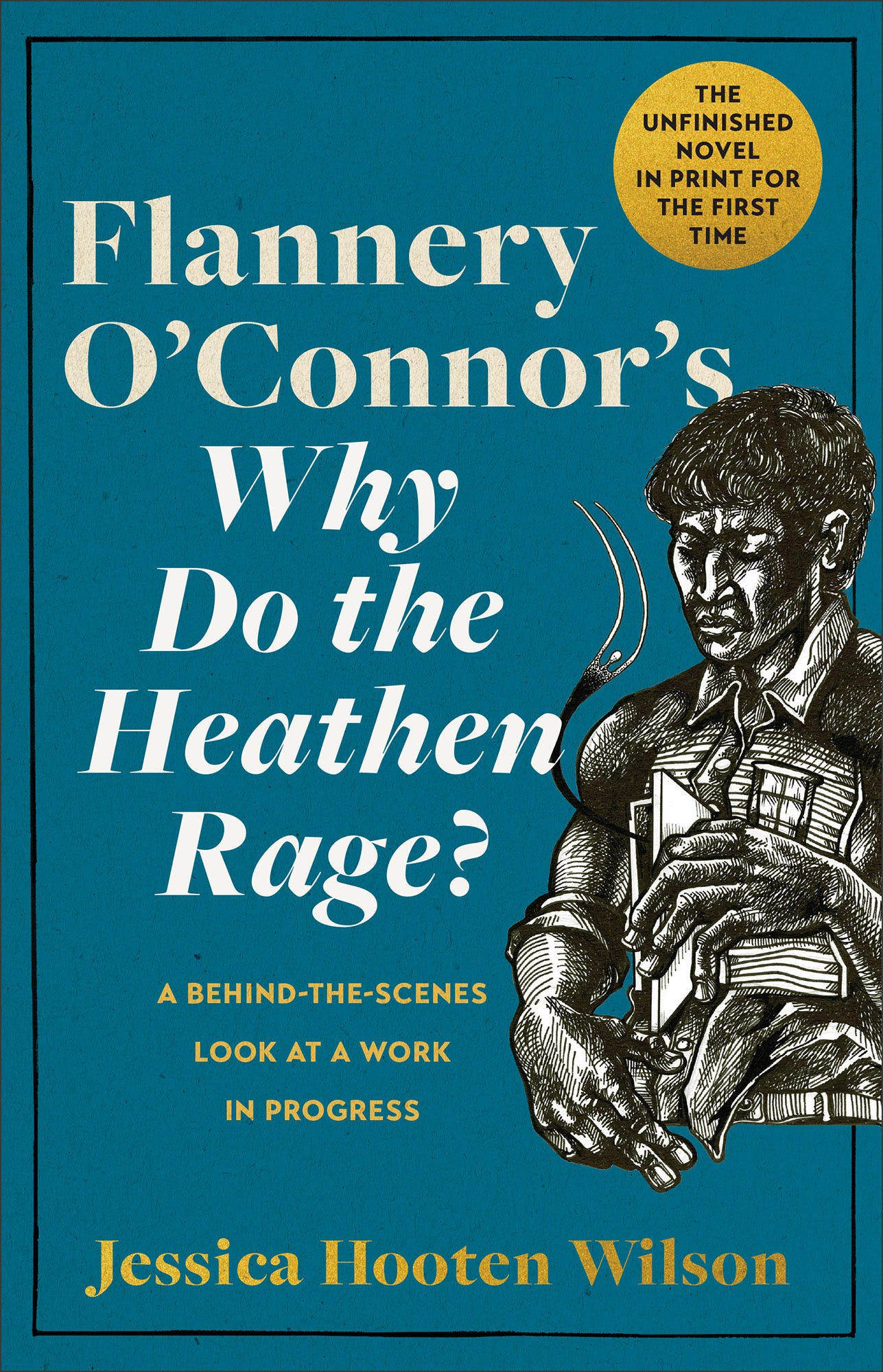
Jessica Hooten Wilson, Flannery O’Connor’s ‘Why Do the Heathen Rage?’: A Behind the Scenes Look at a Work in Progress: my review. Three Stars on Goodreads.
But let’s end our revival meeting on an upbeat downhome beat. With inimitable Southern grit. (Any LMU Jesuits would recoil from her nuanced if wickedly catty, barbed incorporation of a Freedom Riding meddler, a do-gooder driving down from her Empire State demesne to scold “unreconstructed” hayseed Georgians, one Oona Gibbs, “inspired by” Dorothy Day). From her unfinished novel, I see myself here too.
(Ma’s run interference to save face in public at least for her deadbeat smug smartass secularized thirty-something considerably underemployed son…. ‘“He’s a scholar,’ she said. She had arrived at this term for his semi-occupation as a genteel shield for his peculiarities. She preferred it to ‘intellectual.’ She thought of a scholar as someone who knew too much but remained a gentleman with it all. An intellectual just knew too much.”
You've made it this far, my appreciation…being on the Left Coast, a rare sighting from my stroll through earnest yard sign somnolent Sequoia sempivirens sylvan suburbanites.