Shake them bones, blow, wind, blow
Sage wisdom for those rattled "when the revealed world begins to totter."

“So long as the world moves along accustomed paths, so long as there are no wild catastrophes, we can find sufficient substance for our lives by contemplating surface events, theories and movements of society. We can acquire our inner richness from this external kind of ‘property.’ But this is not the case when life encounters fiery forces of evil and chaos. Then the revealed world begins to totter.
Then the man who tries to sustain himself only from the surface aspects of existence will suffer terrible impoverishment, begin to stagger…then he feel welling up within himself a burning thirst for the inner substance and vision which transcends the obvious surfaces of existence and remains unaffected by the world’s catastrophes. From such inner sources he will seek the waters of joy which can quicken the dry outer skeleton of existence.” So observed Avraham Kook, first Chief Rabbi of Israel.
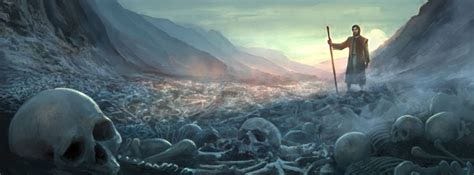
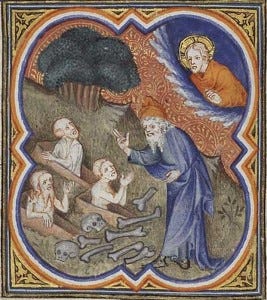
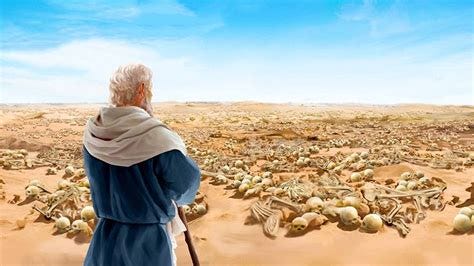
Even biblically bereft me catches the reference to an eerie episode, "the valley of dry bones” in Ezekiel 37: 7-10. Here in its JPS 2023 translation, capturing the KJV tone:
I prophesied as I had been commanded. And while I was prophesying, suddenly there was a sound of rattling, and the bones came together, bone to matching bone.
I looked, and there were sinews on them, and flesh had grown, and skin had formed over them; but there was no breath in them.
Then [God] said to me, “Prophesy to the breath, prophesy, O mortal! Say to the breath: Thus said the Sovereign GOD: Come, O breath, from the four winds, and breathe into these slain, that they may live again.”
I prophesied as I was commanded. The breath entered them, and they came to life and stood up on their feet, a vast multitude.
Robert Alter calls him the “strangest of the prophets,” and his rendering, which voices the rough edges rather than smooth veneers of a repetitive paratactic Hebrew, renders:
And I prophesied as I was charged, and there was a sound as I prophesied, and, look, a clatter, and the bones came together, one bone to another.
And I saw, and, look, upon them were sinews, and flesh came up, and skin stretched out over them from above, but there was no breath in them.
And He said to me: “Prophesy to the wind, prophesy, man, and say to the wind, ‘Thus said the Master, the LORD: From the four winds, come, wind, and blow into these slain that they may live.”’
And I prophesied as He had charged me, and the breath came into them and they lived, and they stood up on their feet, a very very great legion.

The divine wind, the ruach, here blows, Alter notes, rather than “breath” or “spirit.” It comes from the earth’s four directions. As Adam received the life-giving air so here those killed vivify. Alter infers that this “global scope” then “jibes” with return from exile for those so articulated, in the literal sense, who put themselves back into shape.

Once I bought a secondhand novel based solely on its evocative title, The Valley of Bones, seventh in Anthony Powell’s twelve-volume series A Dance to the Music of Time. Four summers ago, I found out a very close relative—who may well have bequeathed me my bookworm genes, indeed recommended this cycle as one of his favorite reads. I bought it on Audible, but have yet to tackle it. Largely forgotten as many of the mid-20c. British literati once lionized are in today’s dismissal of “dead white men” not to mention its privileged class. Checking details, I find it features an not always reliable narrator, 400 characters, and a million words, so perhaps I’d better read it first, then listen at a later date a few years on. I find this a pleasurable pastime when I’m patient.
![A Dance To The Music Of Time [Complete Series] by POWELL, Anthony: Very ...](https://substackcdn.com/image/fetch/$s_!Ju3w!,f_auto,q_auto:good,fl_progressive:steep/https%3A%2F%2Fsubstack-post-media.s3.amazonaws.com%2Fpublic%2Fimages%2Fbbd111db-2ee5-426c-99b2-eaed7c2f1cf3_300x336.jpeg "A Dance To The Music Of Time [Complete Series] by POWELL, Anthony: Very ...")
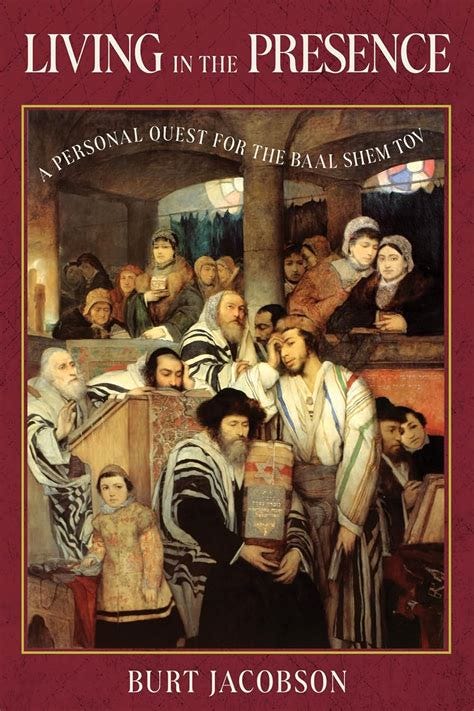
Luckily, his biographer Hilary Spurling’s published a handbook in 2005, as a necessary vadamecum. I tend to go for longer, deeper dives into fiction nowadays, heady, dizzier plunges. Another extended excursion into mystical, prophetical, and erudite realms I took recently revealed a passage into desolate terrain similar to Ezekiel. I excerpt this from my full-length Goodreads review of Rabbi Burt Jacobson’s Living in the Presence: A Personal Quest for the Baal Shem Tov. (On November 19th, Monkfish will release this.)
He shares insights of Estelle Frankel, a psychotherapist and Kabbalah practitioner:
“While all transitions provide an access point to the sacred realm, the experience of losing a loved one can be a particularly powerful trigger for spiritual wakening. When someone we love disappears, we immediately develop a relationship with the invisible realm. And as we continue to feel connected to someone who is not in the finite world, our connection to the infinite, the God realm, is potentially activated."
Jacobson applies Frankel's perspective to the wisdom of the legendary 18c Polish hasid tagged by his rabbinical acronym as the Besht. "He doesn’t see suffering as a punishment for sin. Rather, he adopted R. Isaac Luria’s view that suffering is a metaphysical flaw that came about during the creation of the world. Before fashioning the universe, God was all in all, but in order to make a place for the universe God had to first withdraw (tzimtzum) into Godself. This is where the problem of human affliction had its ultimate origin. As the Baal Shem taught: 'In the beginning, God was everywhere, divinity was all in all. But in order to create the universe, God had to withdraw from the whole, limiting the domain of the divine. This contraction occurred throughout the universe, for the Infinite contracted itself so that existence might receive its light. Separation and suffering—without these there would be no universe.'
Adversity, then, is part of the very fabric of existence, not to be ended until the era of the messiah. But in Luria’s cosmology there was a second tragic act that occurred during the process of creation that made matters even worse. An unexpected cosmic shattering (sh’virat ha’kelim) took place bringing about chaos on a universal level. It was this brokenness that separated the Shekhinah from the blessed Holy One. And yet the {Besht} was in agreement with Luria that human beings have a potential to heal this cosmic brokenness and to alter the face of existence, for they understand how to bring about cosmic unifications that can restore the wholeness of existence. R. Jacob Joseph writes, 'I heard from my teacher, the Baal Shem Tov, that all the tribulations that affect this world come about when the Shekhinah is not united with her Lover. But when such a unification takes place, suffering is sweetened and is transformed into compassion.' Notice that suffering is sweetened, not ended. The real miracle is that suffering can be transmuted into compassion."
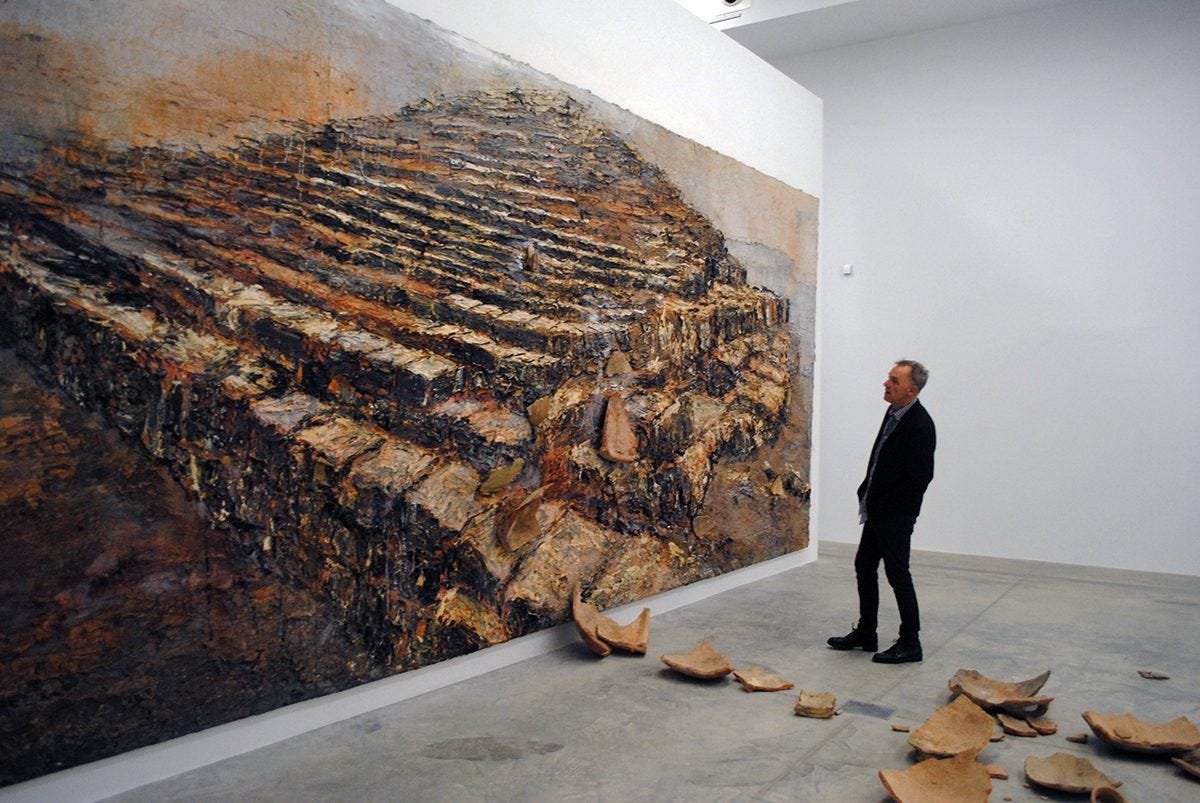
Anselm Kiefer, ‘Shevirath Ha Kelim’ (2009), Kiefer Pavilion, PLANTA project, Fundació Sorigué, Lleida, Catalunya/ Spain
I’m trying to keep this entry compact, not to repeat personal recitals of loss. I share these passages with you at a moment when many express sorrow, have voted out of their longing for a happier future and stable present, yet watch as values, prices, and policies appear to lack alignment with commonsense or congruence. They, and their dissenting neighbors on the other side of picket fence, cubicle, hallway, or pillow who laud identity initiatives and praise radical transformation, a week later now wonder where their salvation will come from. I advise equanimity, balance, poise, equilibrium.

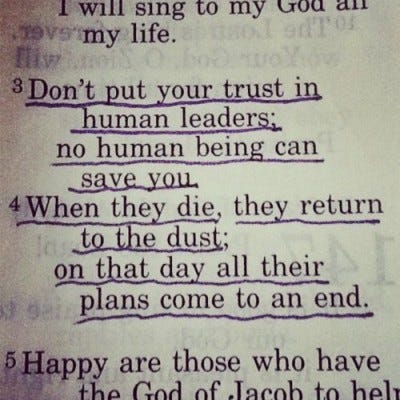
Every Election Day, the admonition from Psalm 146:3, which I prefer in the phrasing of a song sung long ago at Mass, rather than any version I can find, as “put not your trust in princes, in man in whom there’s no salvation. On the day his spirit departs he turns to dust, on that day his plans die.” (I may’ve exhausted above my insignificant widow’s mite of Catholic school-inculcated Holy Writ committed to wavering mind. Above, Stephen King, who probably’s runner-up to the Bible in sales, “translates” It. More eloquently than a bland, by-committee, pluralized, too-generic formula below.)