
Sehnsucht, or why ask why?
C.S. Lewis, Brian Eno, Mazzy Star, neurons, lifelong yearning

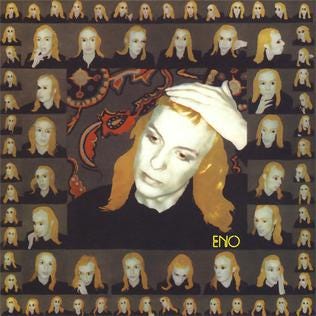
Last post, I included both Roxy Music’s 1972 debut + Eno's ‘74 Taking Tiger Mountain in 12 LPs that stuck. My penultimate entry promised not only dogs + rock'n'roll but Sex + God. Wherein I name-dropped C.S. Lewis' apologetics (i.e., defense of belief).
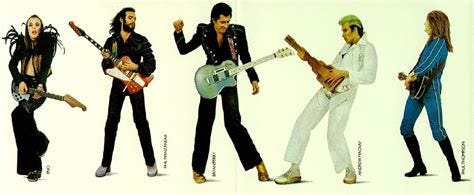
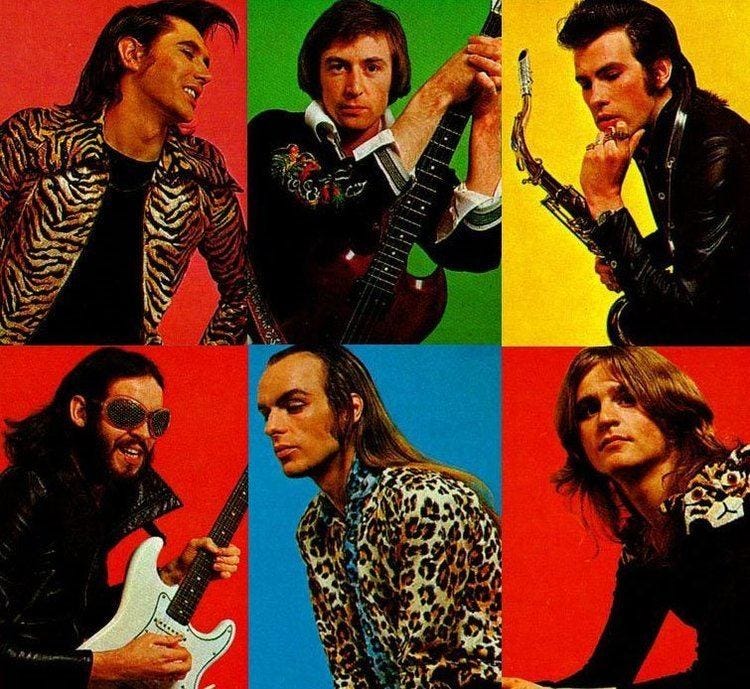
“Why ask why?” sighs Eno on the wispy fade of his last spin with Roxy, submersive final cut, title track of For Your Pleasure. If their first record beamed down, as Antony Price's gatefold of the ensemble playfully depicted, the English lads (mostly) straight (yes even Eno was straight in feathers: the “birds” flocked to his backstage bower) outta art school aliens decked out in Golden Age of Science Fiction get-ups, blaring, braying, and sashaying Fifties slick, Forties noir, and flapper chic into a distorted upending of rock conventions already ossifying post-Sixties, then the follow-up anticipated lounge louche cabaret Weimar swagger and continental casinos royales and decadent melody. Alongside R.E.M. Murmur and The Who Sell Out, my top 3 LPs.
FYP sticks, for it’s the last our genial hosts cued on the turntable at their Echo Park home, a short walk (though we drove, ferrying my spouse’s dinner contributions) from our hillside dream cottage she’d, as I ruefully and proudly joked, labored with my/ our/ her retirement savings, into restoring, studs up. (I allude to the “liberal mugged by reality, aka can’t fight L.A. City Hall's endless Legal Aid largesse” backstory here.)
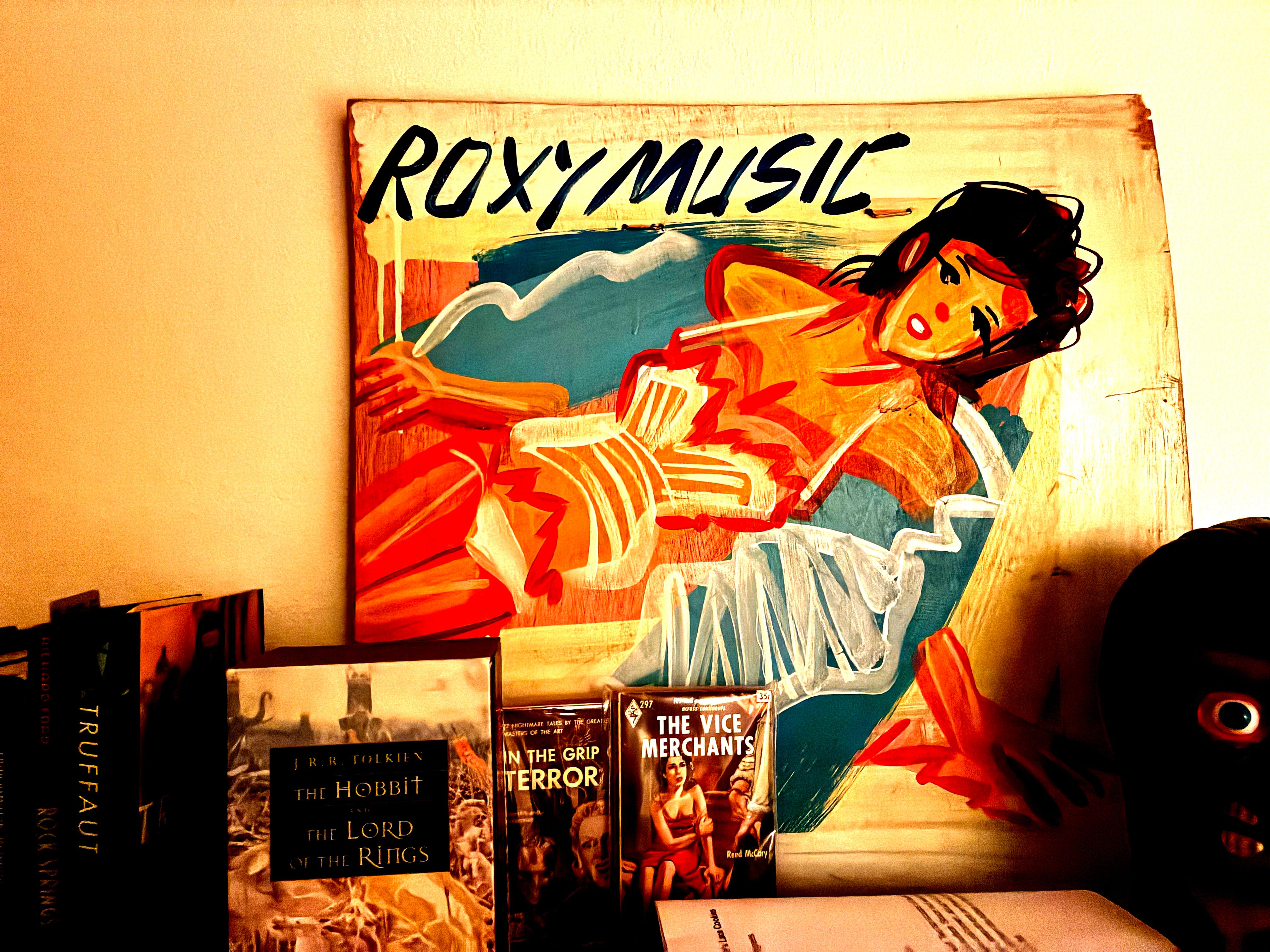
Son #1 rescued her from a dumpster behind a Chicago record store. Safe in PDX.
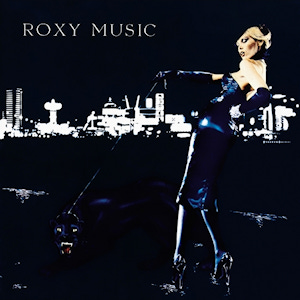
I can’t conjure FYP, Roxy\Eno increasingly in heavy rotation on my go-to stream (though I like Roxy self-titled maiden voyage and tamped down martial artsy Maoist send-up Long March Tiger best) as early 70s loom louder in my mental soundtrack as adolescent comfort food, reheated in my Oregon solitude) without that pre-mortem recollection, Poignantly, I opened Spotify to draft this astral New Years launch, as Eno's campier, vamping, glamping travelogue popped up in my night-owl algorithm.
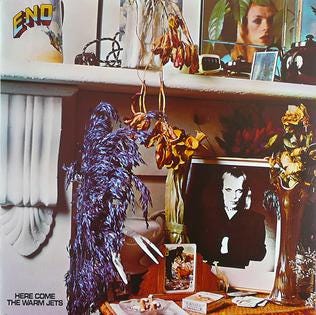
Here Come the Warm Jets (the phrase visually leaks out on the cover, naughty novelty Victorian postcard of a girl taking the literal piss, semi-obscured in tatty clutter) chortles and shimmies, giving Eno + crew room for elbowing aside former frontman Bryan Ferry, while wisely keeping Roxy mates on board for seasick flash fop prog.
I type this as “Some of Them Are Old” concludes that (also) ‘74 disc, a look back on days in a life, a heartbreak slide guitar break. If Yahrzeit La Tengo memorialized my wife's passing a year after, last March, then that playlist can find its counterpart, at least for song one with twenty to go, with my/your tribute post-facto over my resting place, my stilled spirit since youth filled with the processed sounds I’ve loved before I depart this mortal coil. Kids, subscribers, pals, start your “celebration of my life when doves fly pre-need” afterparty prep, seeing you won’t spring for a grave, me ashes to dust. Topically tonight, in sync, HCTWJ begins with Eno yodeling “Why ask why” too.
I’ve been told by multiple (im)patient readers many of my blog pieces hurt brains and wear out attention spans. Rather than solve theodicy as CSL tried (unsuccessfully no less than Job, Aquinas, Pascal, Chesterton, or my theology profs and/or priests in my opinion as a skeptical stubbornly searching not finding pilgrim over decades), let's settle for a scattered sort: as seekers along this path we all must tread, more fools us.
I'm sharing recent glimpses from mainly Christians convinced by what hasn't swayed me. Perhaps you can relate? I admit a life longing to figure out by brainpower and will what appears to many I know as a 1) irrelevant 2) irrational 3) insane 4) impossible 5) immaterial 6) indifferent 7) insipid (mix and match) inquiry. But a Big Question which this year I face: that dread demographic category without -18/-35/-49/-55 as its ending date, box to check pending the six-foot model six feet under (or an urn on the mantel).
Speaking of Christian/s, let's dive into “The Tune of Things.” NYT’s David Brooks named it a must for 2025. December’s Harper’s sparking a rave by eco-critic turned convert Paul Kingsnorth, whose The Abbey of Misrule features in my Substack recommendations. I’d already bookmarked it after catnip for me, a cover teaser lede: “Is consciousness God?” A noted poet, Christian Wiman leaps in where fools fear etc:
. . .Iain McGilchrist’s The Matter with Things, a candidate for the best book I’ve ever read. McGilchrist is a psychiatrist, neuroscience researcher, and polymath who has focused for decades on the asymmetry of the hemispheres of the brain and what that means for how we perceive ourselves and the world. . .here’s the gist. The right brain sees in wholes (the gestalt), whereas the left brain loves systems. The right brain knows what it doesn’t know. It’s the source of intuition and transformative leaps in all disciplines, including math and science. For the left brain, anything outside its purview is irrelevant, wrong, or invisible. The right brain imagines; the left brain analyzes. The right brain produces (and understands) metaphor; the left brain is more rigidly literal. Poetry comes from the right brain but, interestingly, language comes largely from the left. And that right there is a key to understanding our divided brains: though we can speak of their different capacities, in fact the left and right are indissolubly linked and can’t function healthily without each other. But this health—individual and cultural—depends upon the right brain, which is larger, being the master, and the left brain being the emissary.5 We have reversed that order.
Does this even need to be illustrated? Speech codes, identity politics, cancel culture: left-brain bullshit. DOGE, killing every grant that has the word “diversity” in it, even if the word refers to insects, cancel culture: same. But this goes far beyond politics and culture war. Militant atheism, scientism, religious dogmatism, tribalism: all this occurs in cages its inhabitants have ceased to see. The first quarter of the twenty-first century seems like some massive insult to the right side of the world’s brain: billions of us staring catatonically at screens, unable to form durable attachments, slicing time into ever-smaller increments for the sake of efficiency (and control), even as we feel its ever-faster passage crushing us.
After elaborating his appreciation of McGilchrist's endeavor, Wiman cites atheist philosopher Simon Critchley, whose new book on mysticism conjures up doubt.
But one runs into a wall at some point. The wall is called suffering. It can be internal or external but in any case renders those little whiffs of aesthetic bliss impotent. Even repulsive. Here’s the reason Critchley gives for writing his book:
I begin from the feeling . . . that we’re all lost, we’re all lonely, we all find it difficult to believe in anything, to commit to anything, to live in a way that feels truly alive. In short, we inhabit a world of woe.
Doubt tears away at us like rats gnawing away under the floorboards in the house of being. It is like an existential eczema that we scratch at under our clothes . . . and leads us ultimately to the question of whether to be or not to be.
That’s an ambitious “we.” I wonder if it refers mainly to people who read too many books, those with chemical imbalances, and the destitute. I fit into the first two categories and have written a book “against despair,” so I’m part of this drear choir. But I know a lot of people for whom Critchley’s words would seem, at the very least, myopic. And even if this is the way our minds relate to our world, is art really an adequate antidote? For some, I expect it only exacerbates the disease.
C.S. Lewis responded to pain first, in decidedly donnish detachment (as if a comforter of Job as he scratched his boils with potshards on the dungheap) as a fervent non-believer who’d read his way into God and soon Christ. Then after intimate loss, as a widower after Joy Davidson, a less fetching character than Shadowlands leads Debra Winger and Anthony Hopkins would lead you to, uh, believe. Lewis scholar Bethany Sollereder in Why Is There Suffering? Pick Your Own Theological Adventure takes a “novel” open-ended flowchart approach, which ingeniously if too predictably leans towards expectations you’d reckon from a Midwest mainstream Protestant publisher.
Unlike Wiman at Yale Divinity School or at Oxford, CSL and his successor Sollereder (I’ve spent hundreds of hours studying the Inklings—I’m Two degrees removed from Tolkien—alone, and thousands pursuing faith-based, agnostic, nonbelieving, pagan, and Eastern orientations towards these ethereal eternal quests, often as headphones accompany my sonic or streamed companions in my armchair, cubicle, commute, or walk: art[-rock] as adequate antidote to what ails me?), I can't align with certainty. My soul's earnest quest appears shadowed over…San Juan de la Cruz, en la noche oscura.
I reviewed a great audio performance by B.D. Wong of Ken Liu's 2023 eclectic, slightly egotistical, and engagingly annotated Dao De Jing. Liu opines neither heaven nor earth care about us. Baird (see below) and bard concur. “Straw dogs,” Lao Tzu's fifth verse, has always intrigued me. Liu adds a chilling commentary quoting a Chinese sage's fear that the stuffed effigies, their funerary disposable function over, get not tossed into a deplorables' scrap heap, but must relive their fate perpetually. Why I ask why.
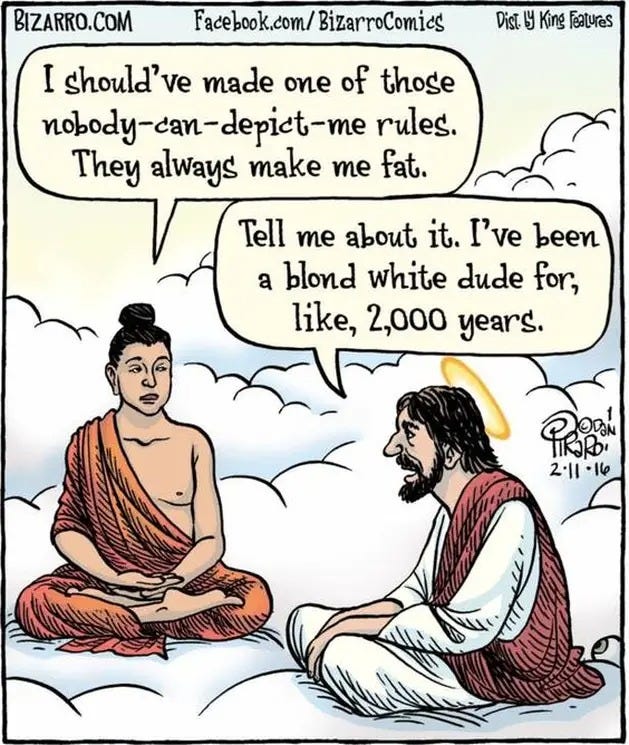
For liturgical art historian Hilary White, a “revert” in the 90s back to Catholicism, she begins her Substack essay "The Silence of God in a World of Noise" promisingly.
A close friend has struggled with this question for years, and I know he’s not the only one (because I’ve been there too): what are we supposed to make of a God who seems entirely silent? What does it mean when we pray and nothing happens, when we ask for help and hear nothing in return? And how are we expected to build a relationship with Someone who does not appear to speak at all? . . . .
White responds that given the woebegone state of the Church in which I (and her friend and she?) was raised, its lack of guidance in a warmed-over, group hug, therapy-not-ritual delivery of doctrine isn’t conducive—in the root sense of leading with us as we seek inspiration—to insight. However, she avers that the fault isn't in the stars, to paraphrase Shakespeare (as I do White, my terms not hers), but in our hapless state, too clueless to buckle down, discipline our lofty sentiments, and work hard at prayer.
Ross Douthat, more right-tilting than Brooks NYT token pundit, influenced my search as I (my wife joshed at my bumptious “fascist” tendency) drifted, unmoored in my blue-collar upbringing from “let’s bail out bankers” vs. “basket of deplorables” bien-pensant NPR haven of SoCal upper-deck fellow travellers. As a teenager, Ross followed his mother into Catholicism. I sense a Burkean political view: “Chesterton’s Fence”.
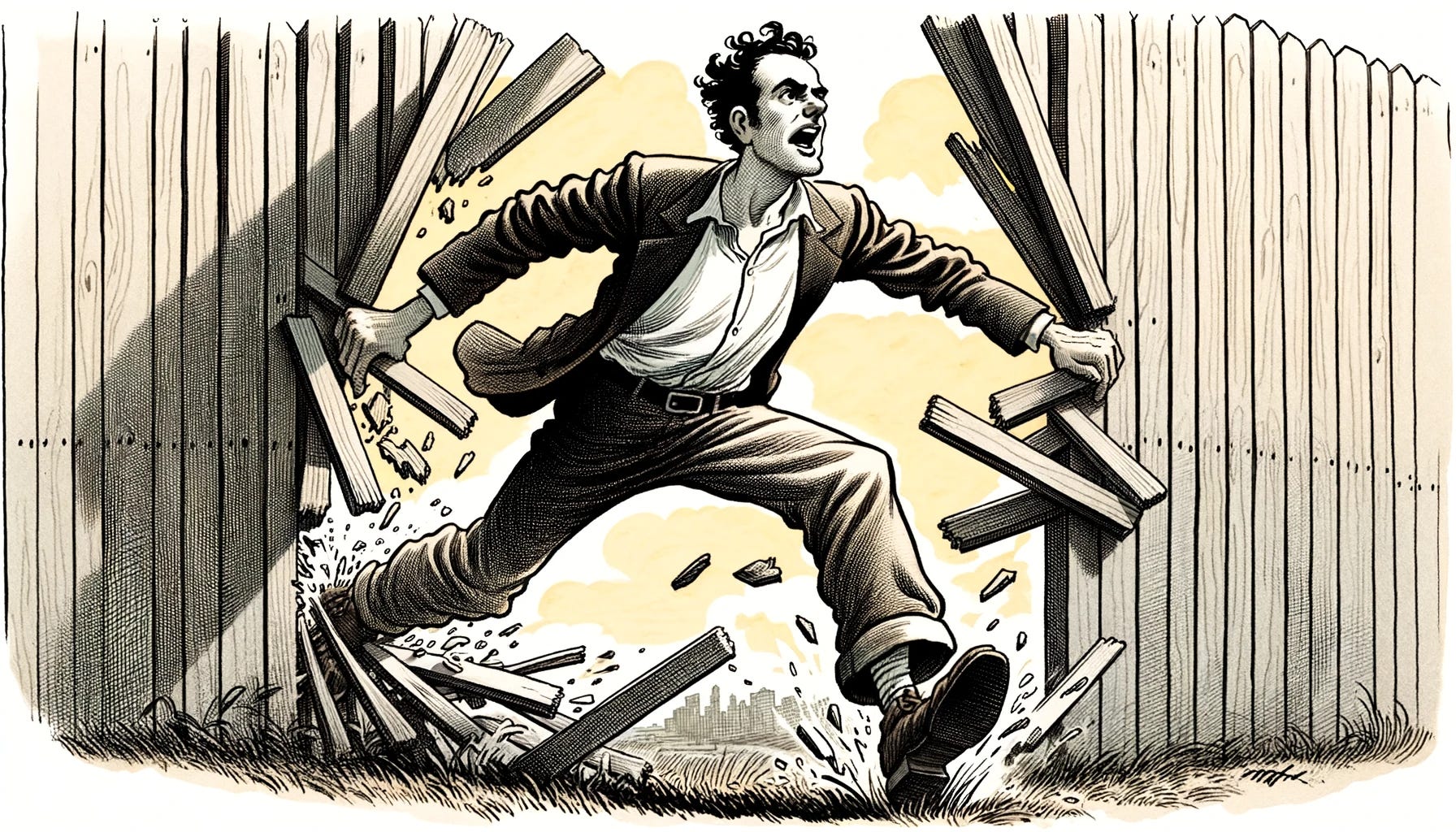
There exists in such a case a certain institution or law; let us say, for the sake of simplicity, a fence or gate erected across a road. The more modern type of reformer goes gaily up to it and says, ‘I don’t see the use of this; let us clear it away.’ To which the more intelligent type of reformer will do well to answer: ‘If you don’t see the use of it, I certainly won’t let you clear it away. Go away and think. Then, when you can come back and tell me that you do see the use of it, I may allow you to destroy it.’
Burke warned during the French Revolution. G.K. Chesterton a century-plus later. Burke inspired GKC, who did CSL. I wonder if that last eminent academic knew post-WWII another, recently departed thinker who struggled with a faith which eluded him, even as Sir Roger Scruton expressed eloquently his affection for beauty, (classical and not rock!) music, fox-hunting as environmentally defensible (didn't convince me but he’s worth hearing out), French wine, and aesthetics in a contemporary landscape devastated by development and amidst cruel cities leveling venerable structures for Brutalist towers…and churches, in his native England. Ironically, I learned of him via a crediting of him as model or target of R.E.M.’s riposte “Sad Professor,” and my dive into Scruton, son of a Marxist schoolteacher, pointed me to Burke's “democracy of the dead” concept upholding careful renovation instead of demolishing (borne out in the iconoclastic and destructive summer of 2020-style) the past without a pause to reflect.
Back to disciple Douthat, Ross counsels a “fake it ‘til you make it” regimen. (For a punishing takedown of his “God in the Gaps” fallback position which didn't wow me either, try to find an unpaywalled access--I used Libby app via my library—to Robert P. Baird’s Jan. 16th 2026 NYRB slam.) Go to services, adapt habits of the worshippers, seek counsel, beseech illumination. If that Hail Mary Pass fumbles, “the reasonable religious conclusion has to be that skepticism no less than suffering belongs to the divine plan, that whatever calibration made this universe very good to create also requires space for some of its denizens to believe that nobody created it.” Cold Comfort Farm instead of babe in a manger, Baird snipes after finishing Douthat's Believe: Why Everyone Should Be Religious (same press as Sollereder) how he emerged more not less affirming that the only purpose humans possess is our embodying universal entropy, the Second Law of Thermodynamics. This past April, Douthat expounded his (flimsy) thesis in this astute critique from Bari Weiss of The Free Press. He relies on standard proofs. TFP denies free entry; Spotify or subscriber platforms for podcasts may unlock it. Or see this no-charge half-hour PBS interview/ transcript.)
I stopped in my local parish (the barn-like, steeple-free 1959—with full drum kit and giant amps next to the altar—sanctuary is locked and you need to be buzzed into the office for a side chapel) to pause after a brisk six-mile trudge. Hair awry, Irish wool beanie, hooded jacket, and jeans I staggered up the steps looking as if pursuing Bigfoot. “That man has a big beard!” Girl to gramps as I overtook on the trail earlier. I’ve prayed not for myself when dipping into a sacred place, but for those who ask me, and others who will never, on their behalf. Including all of you, seen or unseen. I started this occasional practice after visits a dozen-odd years ago to doctor or dentist. South Pasadena, 1924 edifice, doors opened, which would pass Scruton's soft scrutiny.
So that's my reconciliation. I’ve attended pre-lockdown in first Alhambra then East L.A. the archdiocesan-then approved (later peevishly rescinded by Pope Francis, who I, unlike most, couldn't rally around, suspecting his P.R. and M.O.) Latin Mass, from which I took comfort in Douthat-Scruton fashion, relishing the reverence and quiet, no hand-holding, no Pentecostal rapture, no happy-clappy sing along. Simple respect, a sermon in back-and-forth Spanish (congregants 98% immigrant/Latino) and English.
Was I the sole agnostic soul in the humble pews of a chapel hacked our of a cliffside by refugees from the Cristero rebellion against the “red” Mexican caudillo regime of the 1920s? There I found a measure of tranquility, if in unresolved juxtaposition with my affection for my Jewish affinity, a tangle over half my span on earth by 2026. If not able to commit my fealty, distancing myself from ideological and social stances its stolid adherents tended to espouse, me neither being a pro-capitalist nor integralist.
Since, my “co-exist” Franciscan ecumenical community disagreed with “my” f-word “reactionary” alternative, as they castigate “Christian nationalism.” (Climate change, “migration” without oversight, power consolidation under A.I., globalism, Islamism, and indoctrination occupy my frets.) But bringing up tough concerns brings us back to what I predict matters to you, not papal encyclicals, fusty profs, or fussy Oxbridge.
Which is where CSL—who could akin to GKC talk about religion to wary audiences unlettered, radical, or bickering—-imagined what joins secular to seeker, pious with hedonist, acolytes with anarchists, progressives with never-whomevers. How to live together, in the few-score revolutions around the sun we’re at our luckiest granted. I know few of you care about these last mind-bending or densely digressive paragraphs. Nevertheless, I thank your indulgence as like Jacob, @4 AM I wrestle my “arch” angels.
And as a boy, as biographer Alastair McGrath tells us of his fellow Ulsterman-in-the-making, CSL sought what I hazard may be a lifelong yearning, if hidden by naysayers.
The low, green line of the Castlereagh Hills, though actually quite close, thus came to be a symbol of something distant and unattainable. These hills were, for Lewis, distant objects of desire, marking the end of his known world, from which the whisper of the haunting “horns of elfland” could be heard. “They taught me longing—Sehnsucht; made me for good or ill, and before I was six years old, a votary of the Blue Flower.” We must linger over this statement. What does Lewis mean by Sehnsucht? The German word is rich with emotional and imaginative associations, famously described by the poet Matthew Arnold as a “wistful, soft, tearful longing.” And what of the “Blue Flower”? Leading German Romantic writers. . . used the image of a “Blue Flower” as a symbol of the wanderings and yearnings of the human soul, especially as this sense of longing is evoked—though not satisfied—by the natural world.
I sign off with a weary wistful wish for cheer this calendar flip. Steve Skojec, to whom I've pointed in past entries, has endured loss and longs for gain in his parallel path. It's impossible to compare or contrast unwanted termination of his marriage (I speak from sorry experience pre-dating finding my soul-mate) with that sudden death of my spouse but we're both dealing with stark apartments in strange towns full of strangers. If you know of folks in lonely circumstances, reach out as either “the holidays” or the ensuing “Ordinary Time” (what “Rome” labels in lectionaries after Advent and before Lent) prove dispiriting to navigate for those of us sailing solo.
Here's a choice from one of Son #2’s dozen. I was enjoying their late guitarist David Roback's first lineup, Rain Parade, when I composed this piece. Not only Byrdsian LP Emergency Third Rail Power Trip but 1982’s Paisley Underground EP Explosions in the Glass Palace hold up as L.A.’s finest in woozy spacey transports orbiting Mazzy Star.