
Drift, grift, shift, miffed, gift
Maps aren't territories, even as I chart my spirit's path mid-flight

Steady drifts away from honesty towards prevarication. That slow sly shuffle from tempered morality to brash pragmatism, sneaking into the ranks armed to win the ideological or political battle. That “I’m not anti-semitic, just anti-Zionist” on the left which grabs memes gets paralleled by those enmeshed in traditional Catholic cabals who can’t let go of the fact that nearly 60 years ago, Vatican II’s Nostra Aetate affirmed a separate covenant for the Jewish nation, that its people had their own arrangement, as it were, with their common Creator. And a few media-influencing, high-profile recent entrees into the Faith, notably Candace Owens, have been allied with “blood libel” rhetoric of supremacist Nick Fuentes, and Putin apologist Tucker Carlson.
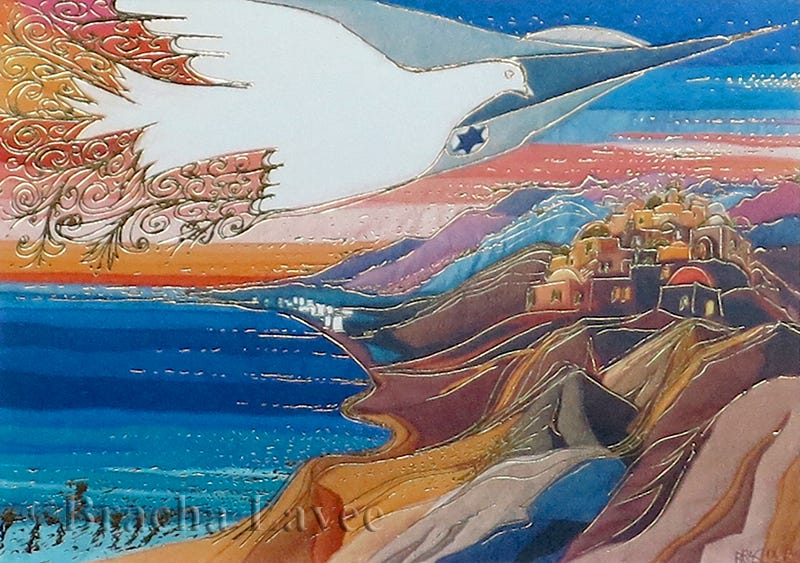
Bracha Levee "Peace Over Israel"
There’s standout showboats, or grifters I won’t link to or name—not infrequently relative newcomers fresh in a heady embrace of “Rome,” who ironically capitalize, exploit, and monetize their opposition to this Church’s firm dictate. Their carping and baiting in my opinion goaded Pope Francis to crack down on the reverent, quickening celebration of Traditional Latin Mass, provoking him, goading his prideful Latin(o) temper. I’m not defending the testy pontiff, but warning; fragile bonds tying marginalized bands together easily fray in triggered tempests. (Here, “victims” or those whom they elect or donate to agitate, baiting the Vatican, may share blame.)
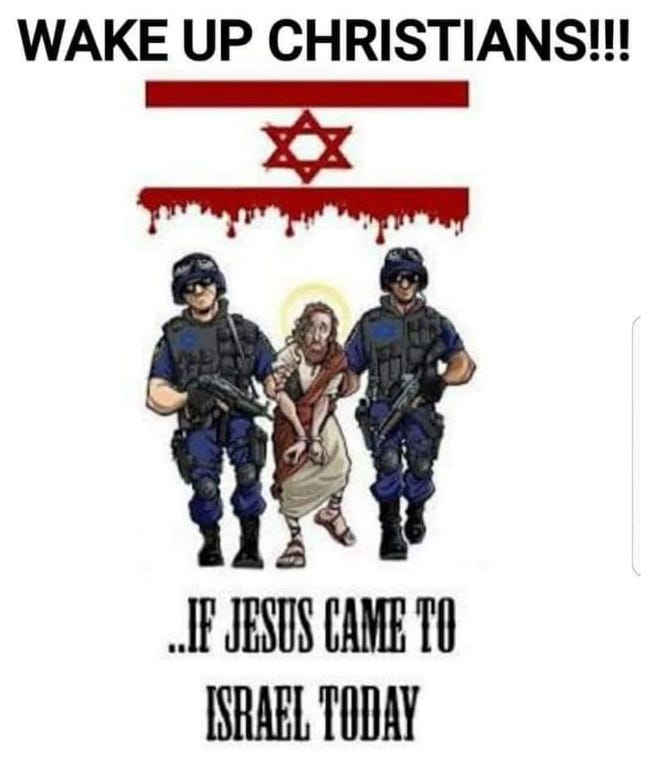
Facebook logo of the group, Christians United Against Israel. Image critiqued.
While no fan of a lot of V2, on this, I must insist, given these concerted denials of this fundamental shift in Catholic orientation which I uphold without any hesitation. I subscribe to two very conservative daily sites who propagate “extra ecclesiam nulla salus” (outside the Church no salvation). Plus, continued dismissals of Israel’s claims to inherit the Holy Land. Zealous Christians of “progressive” denominations, under the aegis of the World Council of Churches, both propound anti-Zionism and assert that Israel’s an apartheid state, even as fundamentalists may favor Z. for dispensational reasons, as the Second Coming can’t happen before the Temple’s back for a third time, and the mass baptism of the Jewish community must precede Christ’s return.
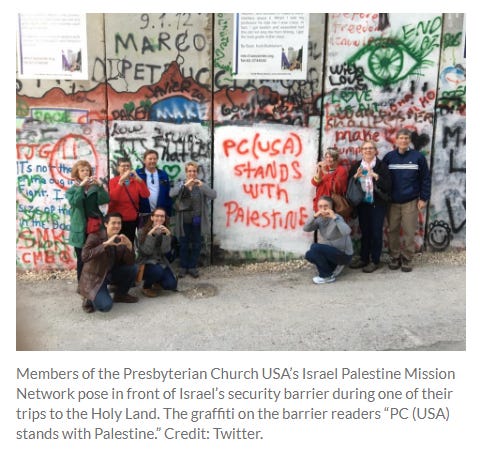
Consider Matthew Wiseman, not of Jewish descent but a Noahide “Messianic” background, apparently Evangelical Christians who follow the Law of Moses (I confess confusion), interviewed about his conversion: “I discovered that the Church’s flaws had been greatly exaggerated. The supposed massacre of Jews by the crusaders in 1099[*} almost certainly never happened. And while serious wrongs were certainly committed in 15th century Spain, the scale of them has been greatly exaggerated.” Having heard this claim just before reviewing vivid, harrowing transcripts, whether adjudicated under banners of Rome, Spain, or Portugal, narrated with documentation throughout Howard Sachar’s 1993 “Farewell España: The World of the Sephardim Revisited,” it’s miffed me greatly, to put my irk mildly. So I compose this, to correct Wiseman’s egregious errors. {*Among maybe, supra, his “supposed massacre” of Jews was 1096 in the Rheinland. A bloody siege of Jerusalem, 1099, preceded thousands of Jewish and Muslim casualties. Perhaps Wiseman means the latter, but unable to check his book, I note as pending.}
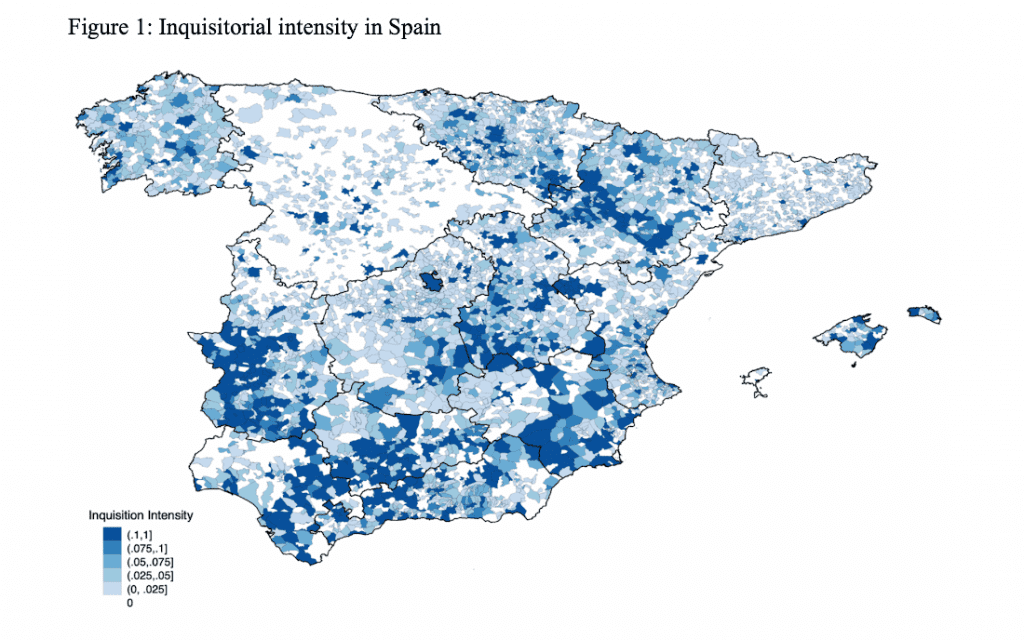
The Spanish Inquisition operated until 1834, technically independent of “Rome.”
"The inner contradiction of anti-Jewish Catholics" on the 59th anniversary of Nostra Aetate comes from “The Philos Project, a Christian nonprofit unraveling the Near East for Western audiences. We are Zionist, pro-Palestinian, and anti-terrorist.” They also spearhead a Coalition of Catholics Against Antisemitism. Last July, looking for an affordable way to learn online about these issues, I completed their (free) astute and informative Pathfinder certificate in “Hebraic Leadership for Christians.” Although geared for “young professionals” 25-35, sort of a Birthright program culminating in an unfortunately age-limited trip to Israel, I found its content both meaningful and quite relevant. They also feature a tie-in with Yeshiva U for a grad stint in Hebrew Studies.
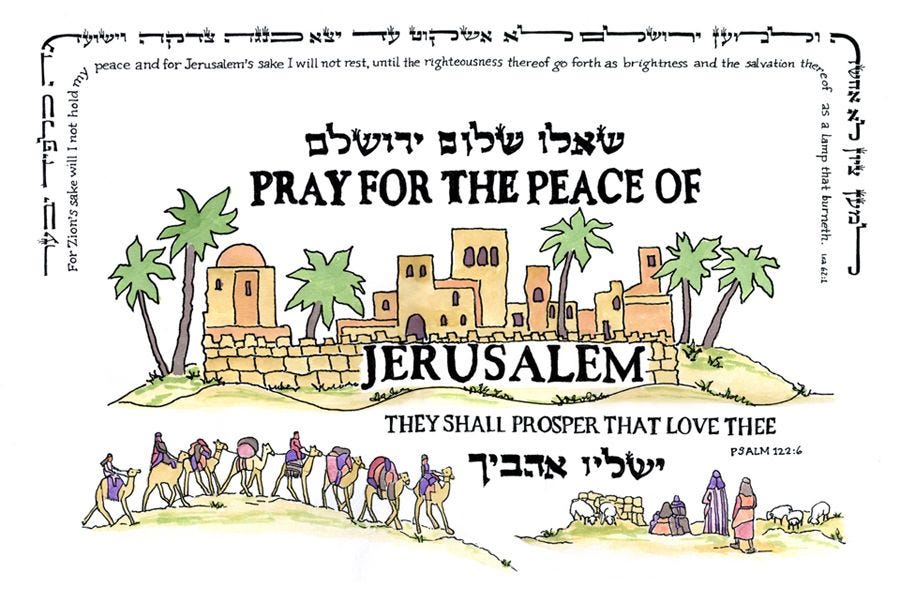
Which is beyond my acumen, budget, or ambition, so instead, I’m reviving my faint grasp from three decades ago of the aleph-bet, but the venerable Rabbi Akiva started serious study at 50, so if not now, when…? If not me, who? I’m also in synchronous weekly bible study of the Gospel reading of the week via Zoom with my lay Franciscan ecumenical colleagues, and in a Parsha portion equivalent in asynchronous modes via Chabad and Sefaria for Orthodox and liberal interpretations respectively. But, do I “believe” what I receive? Or, is “doing,” as in Judaism, the key? As in the practice of the Buddha-dharma, is enacting Sinai’s instructions parallel (at least for a stretch)? Noam Chomsky’s father, William, deftly defined Torah in 1957’s Hebrew: The Eternal Language: it “embraces the totality of Jewish creative labor throughout the centuries.”
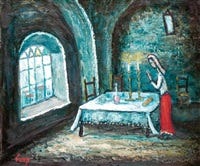
Moshe Castell (1909-1992, Safed/Tzvat, Israel), “Lighting Shabbat Candles”
Check my take on progressive rabbi Remi Shapiro’s Judaism without Tribalism. He hazards the Torah’s all made up anyhow, so don’t sweat it, rather experiment. Yet I can't shake the nagging rejoinder. Why go to the trouble of living Jewishly, shuffling the proverbial “fence” away from the Law? Picking among preferred pieces from the mosaic (small-m) to create a new design, what about inevitable, vulnerable gaps left if one discards old-fashioned, suspect, non-politically correct models? Can a po-mo makeshift composition withstand massed forces arrayed against Jewish assemblages of frayed solidarity with its fragile, flawed S/state (his appendix defines “Jew-hatred” and an acceptable Zionism), which as I type this lash out in a whirlwind to blast it?
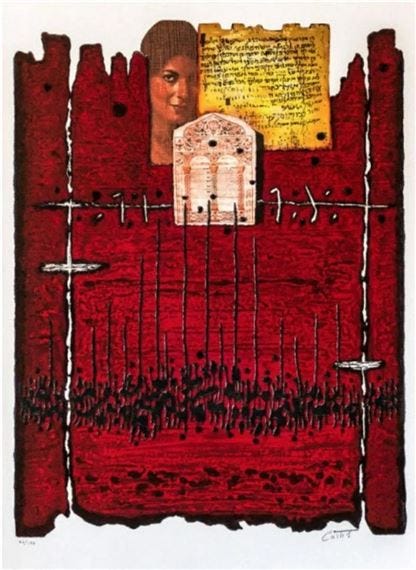
Moshe Castell, “Above Jerusalem,” 1979.
I’ve always been fascinated by the Five Books and Hebrew lore, whereas the Pauline redemption, atonement, “messiah died for our sins” message never resonated with me. The synoptic Gospels (Mark in particular, with its raw, “gedouttahere, you stuck-up unbelievers, and hey, numbskulls, goyische kopf disciples, don’t’cha get Me either?” Three Stooges tone has long drawn me in) do, but they discomfort and unsettle, as Good News probably’s meant to do when you toss aside a “cool rabbi who the Man in the Temple didn’t grok” or “great Teacher, even if H/he wasn’t the Son of God” post-Enlightenment reworking, separating the Jesus of history from the Christ of faith, version doesn’t hold up either, as I review noted NT expert, the prolific Anglican bishop N.T. Wright, in “How God Became King; The Forgotten Story of the Gospels.”
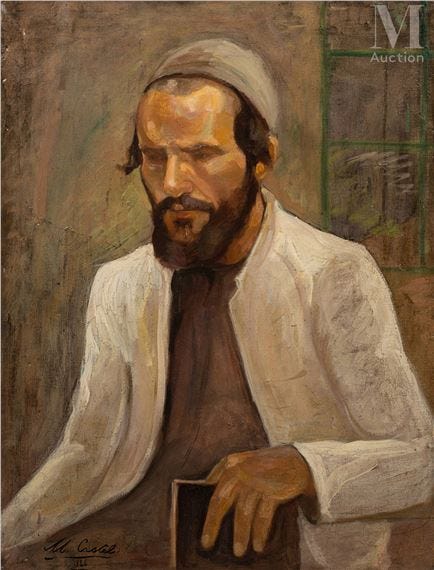
Moshe Castell, “Le Juif Oriental”
Was I convinced? I turned to Wright, whose “fresh translation” fka “The Kingdom” I recommend for the Testament, but came away still skeptical. He explains the crux, the conjunction of the kingdom and the cross, emphasizing the former in the Gospels rather than the latter consigned to creeds. Yet he shrugs off the post-Second Temple 135 CE rabbinic transformation as “private piety,” demeaning real Jewish experience, where for survival amidst Roman persecution, sages finally wrote their Oral Torah down, recorded commentaries, and dispersed students to preserve their transmission.
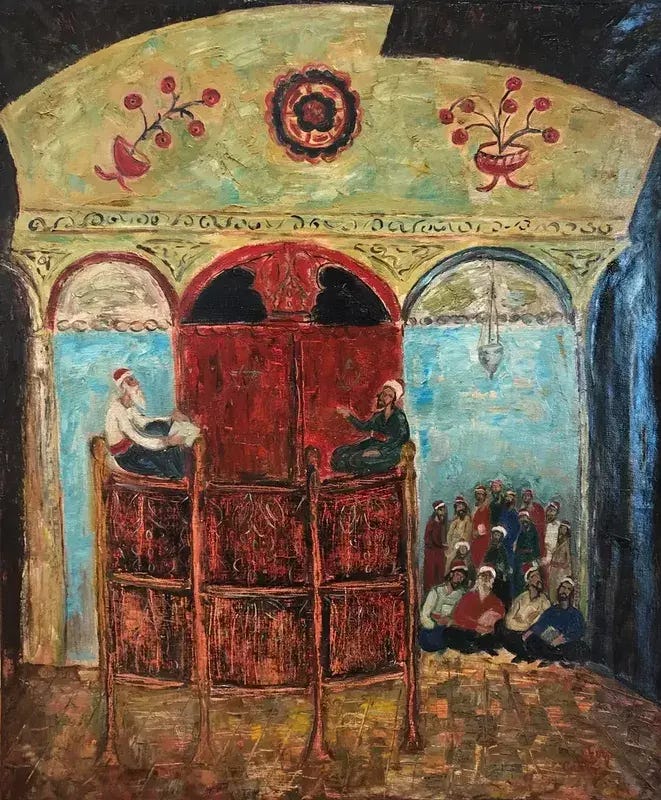
Moshe Castell, “HaAri synagogue, Safed”
I favor (I have a couple of thousand words compiled if you want to hit me up) the medieval theologian John Duns Scotus’ alternative to what became through Thomas Aquinas approved Church doctrine. That is, rather than Jesus coming to ransom “us” for the debt of sin we could never pay back to God, accruing with fatal interest since the Fall in the Garden of Eden, He would’ve have incarnated Jesus among us anyhow, out of pure love for humans, regardless of any flaws, apart from even the Crucifixion.
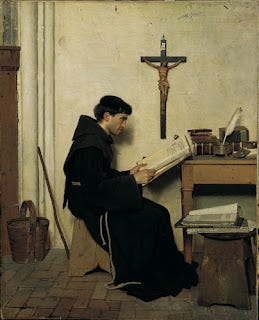
That’d be Duns Scotus, cogitating, always pictured with a skull (not dunce) cap.
I stay hazy, as Scotist thinking is notoriously difficult, leading to its denunciation and imposed “Dunce” (get it?) cap by rivals suspicious of this friar’s minority opinion (and that of Mary’s Immaculate Conception, which didn’t get approved until 1854—and isn’t the same as the Virgin Birth of Jesus; this erudite Celt dynamo from ca. 1300 only got beatified in 1993), about then why Calvary did occur in this schema, but I admit instant enchantment when I learned this in my quest that led to my wary, halting, wavering Franciscan path, six summers ago. I must have skimmed and forgotten it during my own course in this subject, also at LMU, over forty years back. I think it’s the second time in my life that a concept captivated me so powerfully, alongside that of finding the Dao, studying to prep myself for teaching it. Two I’ve felt resonate deep.
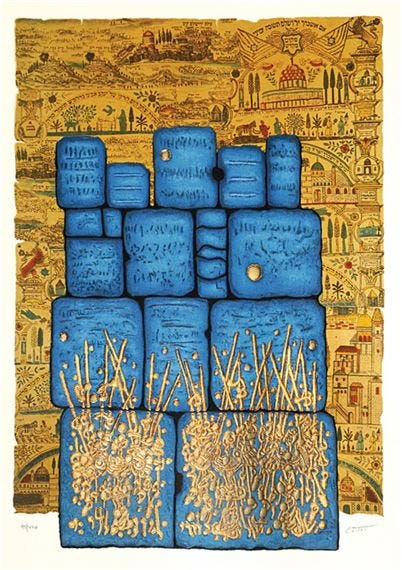
Moshe Castell, “HaKotel” {The Wall}
Thus, as I’ve never been able to affirm that Jesus fulfilled the expectations of the Jewish messiah, and that the redemptive imperative for His sacrifice impelled our having to accept this as our entry ticket into salvation, I guess what freshman year my LMU religious studies professor (they didn’t call it ‘theology’ anymore at that quasi-Jesuit institution) who herself was about to laicize from being a nun, charged me with is true. I’m deep down a DIY Pelagian, “the Celtic heresy,” recklessly despite my own innate skepticism in human nature assuming people can work out their own means to their spiritual fulfillment, that good works matter as much as faith, and that the “felix culpa” inherited—Augustine argued sin’s baked into our concupiscent transmission from one generation to another in the act of generating itself (I did a paper on this in that medieval philosophy course where I must have driven by Scotus in passing, as it was basically Augie plus Aqui) from Adam and Eve’s a “does not compute” nullifier.
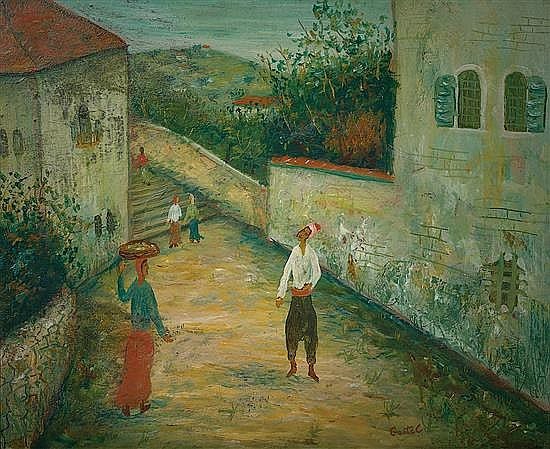
Moshe Castell, “Street Scene,” Safed. 1930
Where does this “leave” me? Given my current condition, best not to conceive myself as feeling stranded. Instead, navigating or coasting in the turbulent wake of my wife’s passing away, and sensing her “bashert” hovers over me. Although a wise friend I respect, as a sparring partner and acute witness to my (d)evolution over the decades insists “you’re not Jewish” (she, being half-such, should know), my “gilgul” circles as do the fireflies balmier nights in Ecuador, back from my gingerly circumscribed but increasingly compromised step back “towards Rome” half-a-dozen years back. Six-plus months after my unwanted widowhood, solo, I waft in free flight, suspended on the thermals in the Andes as in Los Angeles. where maybe-not-after-all-unanticipated conversational encounters with MoT’s and fellow travelers hinted at ticket change mid-itinerary. Seeking, gifted as my kismet, a destination rather than arriving at it full stop. A map’s not the territory. Unless you venture into Borges’ labyrinthine ficciones…
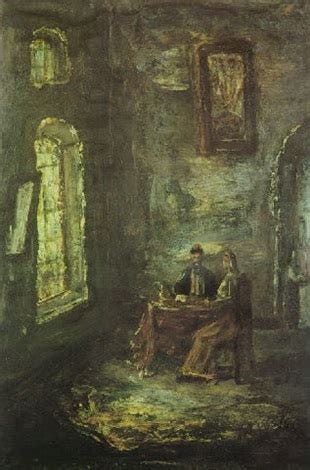
Moshe Castell, “Husband and Wife in a Room.” 1930-1939
On Exactitude in Science, Jorge Luis Borges, Collected Fictions, tr. Andrew Hurley.
…In that Empire, the Art of Cartography attained such Perfection that the map of a single Province occupied the entirety of a City, and the map of the Empire, the entirety of a Province. In time, those Unconscionable Maps no longer satisfied, and the Cartographers Guilds struck a Map of the Empire whose size was that of the Empire, and which coincided point for point with it. The following Generations, who were not so fond of the Study of Cartography as their Forebears had been, saw that that vast Map was Useless, and not without some Pitilessness was it, that they delivered it up to the Inclemencies of Sun and Winters. In the Deserts of the West, still today, there are Tattered Ruins of that Map, inhabited by Animals and Beggars; in all the Land there is no other Relic of the Disciplines of Geography.
—Suarez Miranda, Viajes devarones prudentes, Libro IV, Cap. XLV, Lerida, 1658